If you run a Shopify store and you've ever stared at your Stripe/Shopify Payments statement wondering where all your margin went, I wanted to break down Admoji — a full-funnel e-commerce CRM that promises to plug the exact leaks that quietly drain 7-figure Shopify stores. I went through the actual site in detail, so here's what it really offers, real pricing included.

What Is Admoji?
Admoji describes itself as a "Full-Funnel E-commerce CRM" — basically an all-in-one dashboard that bundles AI-powered ad creation, UGC video generation, your own checkout/merchant account, and a full CRM, so you're not stitching together six different subscriptions to run your store. The pitch is blunt: "Spend your money on advertising, not your CRM."
Crucially, Admoji is built to sit alongside Shopify (or WooCommerce), not replace it — you keep your storefront, products, theme, SEO rankings, and traffic, while Admoji quietly powers checkout, ads, and CRM behind the scenes.
The Problem It's Solving
Admoji's site lays out a pretty specific cost-of-doing-business argument for Shopify store owners:
- Shopify Payments takes a meaningful cut of every order (2%+ per order, per their figures)
- False declines silently kill 8-15% of approvable revenue
- Ad creative can cost $1,000+ per round — and most of it flops
- Most merchants have no visibility into which campaigns are actually profitable (blind spend)
- Customer data, reporting, and ad tools live in six or more disconnected subscriptions
Admoji's own modeling estimates this adds up to $23,000+ in annual leaked margin on a $1M/year Shopify store, or roughly $1,950+ per month in bleed from payment penalties, false declines, wasted ad spend, and redundant tool subscriptions.
Key Features
1. Your Own Merchant Account & Checkout
Instead of routing every sale through Shopify Payments, Admoji lets you plug in Stripe, Authorize.net, NMI, or any processor you choose. Products, variants, and prices sync automatically from Shopify (they claim under 2 seconds per sync), and the checkout includes smart routing, one-click upsells, and retry logic to lift conversion.
2. AskMoji — an AI "Chief of Staff"
AskMoji lets you ask plain-English questions like "What's my ROAS this week?" or "Which campaigns are losing money?" and get an answer pulled from ad platforms, merchant accounts, CRM, and product data in about 5 seconds — no SQL, no dashboard hopping. Admoji claims this can save around 4 hours a day for solo founders running their own ops.
3. AI Ad Engine + Ad Library Seeder
Admoji's ad tools let you research top-performing competitor Facebook ads (scanning 71+ competitor ads across 45+ verified brands per their claims), rebuild winning creative with your own branding, and auto-generate 50-200+ split-test variants in minutes instead of weeks.
4. AI-Generated UGC Video Ads
Upload one product image plus a text prompt, and Admoji generates hyper-realistic UGC-style video ads (product demos, testimonials, unboxings) without hiring influencers or a production crew — then deploys straight to Facebook, Instagram, TikTok, and Google.
5. Real Profit Reporting
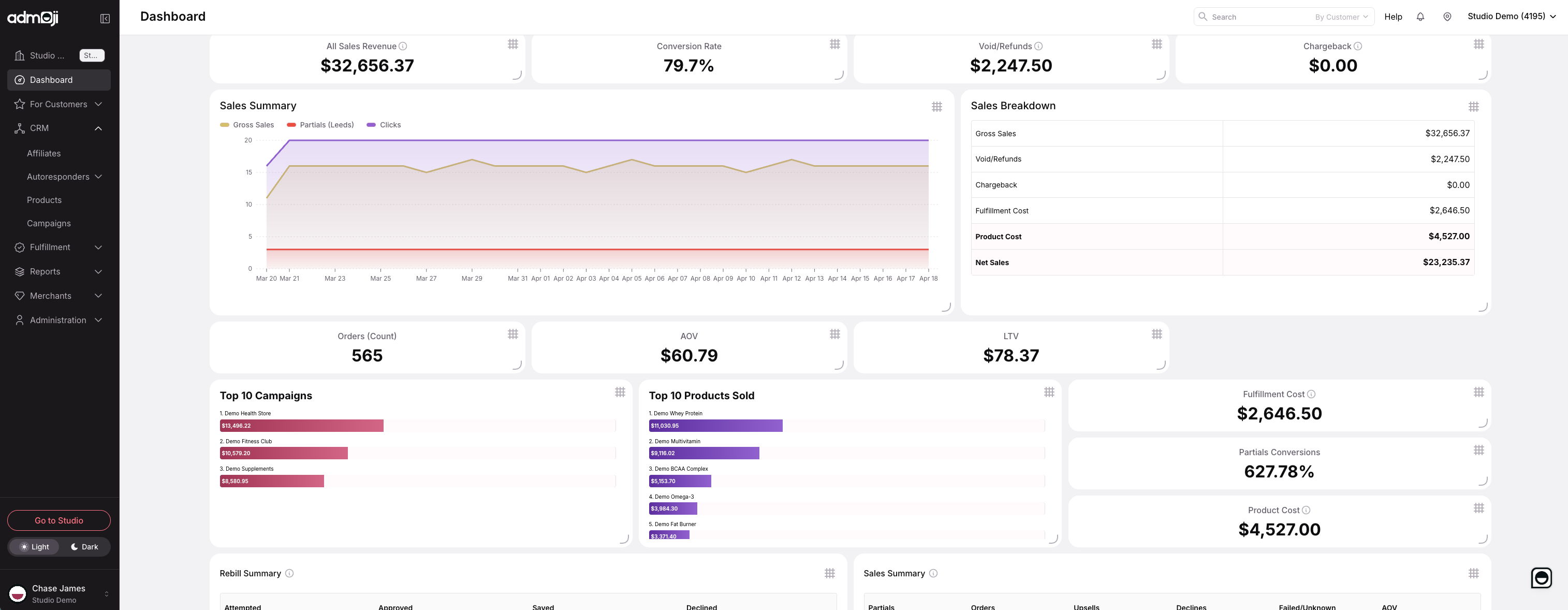
The dashboard shows true net income per campaign — after costs, fees, refunds, and chargebacks — rather than just top-line revenue, so you can tell which campaigns are actually making you money versus just generating clicks.
6. DataPunch BIN Intelligence Integration
A native integration with DataPunch adds real-time BIN-level routing intelligence, claiming a +19.6% approval lift and roughly +$9,915 in recovered revenue per BIN, with a stated 60-second, no-code setup.
7. Built-in Zapier + WooCommerce Plugin
Zapier lives inside the Admoji dashboard (8,000+ app integrations, AI-assisted zap building), and there's an official WooCommerce plugin for WordPress store owners who want the same CRM/attribution layer without leaving their existing platform.
8. One-Click Migration
If you're already on Konnektive, Sticky.io, or Checkout Champ, Admoji advertises a 60-second migration: paste your base URL and password, and it syncs your campaigns, products, offers, and merchant providers automatically — no engineers or CSV exports required.
Admoji Pricing (Confirmed From the Live Site)
Admoji uses a base monthly fee plus a declining GMV volume fee as you scale, with a 14-day free trial on all self-serve plans and no long-term contracts:
- Launch — $79/mo + 0.35% volume fee, up to $250K/mo GMV
- Growth — $299/mo + 0.35% volume fee, up to $500K/mo GMV
- Scale — $699/mo (most popular) + 0.35% volume fee, up to $1.5M/mo GMV
- Pro — $1,499/mo + 0.30% volume fee, up to $5M/mo GMV
- Business — $2,999/mo + 0.25% volume fee, up to $15M/mo GMV
- Enterprise — from $4,999/mo + 0.15% (and lower above $25M/$50M monthly volume), negotiated committed bands
Admoji's own comparison shows a store processing $250K/month would pay about $954/mo on Admoji versus $2,500/mo on a typical 1% revenue-share CRM competitor — a claimed 62% savings, with even bigger percentage savings claimed at higher volume tiers.
Pros and Cons
Pros
- Transparent, published pricing with a clear base-fee-plus-declining-volume-fee model
- Keeps your existing Shopify or WooCommerce storefront, SEO, and theme intact
- Genuinely broad feature set: checkout, CRM, AI ads, UGC video, BIN intelligence, Zapier, and a page builder all in one dashboard
- 14-day free trial with no credit card required, and no long-term contracts
- One-click migration path from Konnektive, Sticky.io, and Checkout Champ
Cons
- Adds a 0.35% (or lower, at scale) GMV volume fee on top of your base subscription — worth modeling against your own margins
- A lot of surface area (9 tools in one) means there's a learning curve to use everything well
- Best suited to established or scaling Shopify/WooCommerce stores rather than brand-new, pre-revenue shops
FAQ
Will I lose my Shopify storefront or SEO rankings?
No — Admoji is designed to work behind your existing Shopify (or WooCommerce) storefront. You keep your theme, products, domain, traffic, and SEO rankings; Admoji powers checkout, CRM, and ads without customers noticing a difference.
How much does Admoji cost?
Plans start at $79/mo (Launch tier, up to $250K/mo GMV) plus a 0.35% volume fee, scaling up to custom Enterprise pricing from $4,999/mo for large merchants. All self-serve plans include a 14-day free trial.
What payment processors does it support?
Admoji lets you connect Stripe, Authorize.net, NMI, or other processors of your choice instead of relying solely on Shopify Payments.
Is migration risky?
Admoji advertises a "done-for-you" white-glove migration experience and a 60-second one-click sync from Konnektive, Sticky.io, or Checkout Champ, with a read-only sync that keeps your existing CRM running during the switch.
Final Verdict
Admoji is a genuinely feature-dense pitch for Shopify and WooCommerce merchants who are tired of Shopify Payments' cut, unpredictable declines, and juggling five separate ad/CRM/reporting tools. The published, scaling pricing (starting at $79/mo + 0.35% GMV) is refreshingly transparent for this category, and the AI ad/UGC video tooling plus AskMoji's plain-English reporting are hard to find bundled together elsewhere. If margin leakage and tool sprawl are eating into your Shopify store's profit, it's worth running the 14-day free trial and seeing the real numbers for your own store.
Start your free 14-day Admoji trial →
#Admoji #ShopifyTools #EcommerceCRM #AIAds #UGCVideo #DTCMarketing