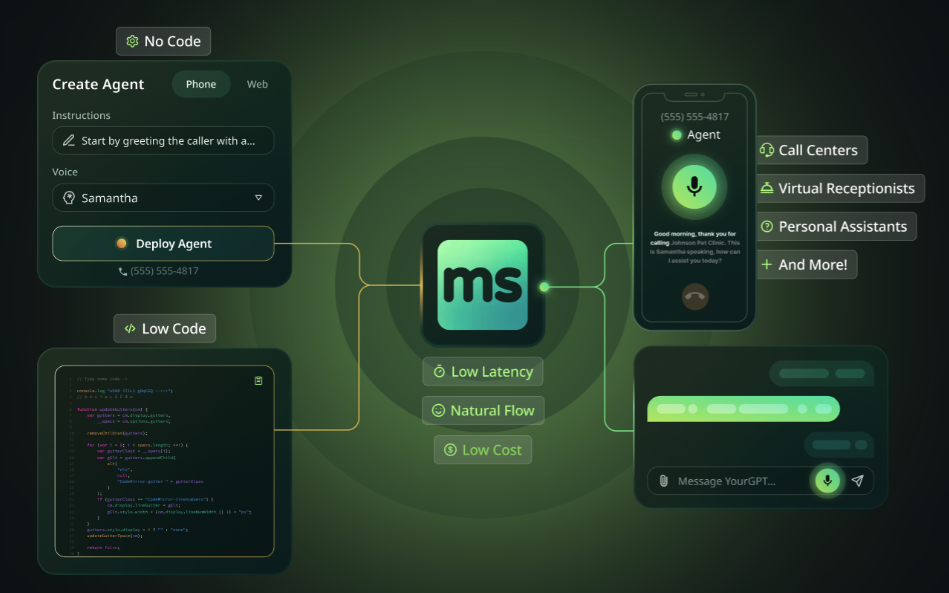
Voice AI usually breaks on one thing: latency. If the agent pauses too long, the conversation feels dead. I dug into Millis AI, which claims some of the lowest latency on the market (around 500–600ms), to see whether developers can actually ship natural-sounding voice agents fast. Here’s my honest review.

1. What Is Millis AI?
Millis AI is a platform for building LLM-based voice agents with ultra-low latency. You configure an agent, connect an LLM, pick a natural voice and deploy across channels — including turning a phone number into a live voice agent with a click. It targets everyone from no-code builders to developers, with webhook integrations to connect other services.
2. Who Is Millis AI Best For?
✅ Developers building voice apps
If you’re shipping voice assistants, phone bots or IVR replacements, the low latency and LLM flexibility are the core draws.
✅ Businesses automating phone support/sales
Turning a phone number into a voice agent suits companies wanting to handle inbound calls or outbound outreach with AI.
✅ No-code/low-code makers
The platform is positioned for non-developers too, so you don’t need deep engineering to launch a basic agent.
❌ Teams needing only text chatbots
If you don’t need voice, a text-only chatbot platform will be simpler and cheaper.
❌ Highly regulated use without compliance planning
Voice agents that call people bring disclosure and consent obligations; you’ll need to plan compliance (see the responsible-use note below).
3. Core Features Breakdown

3.1 Ultra-Low Latency
The headline feature: response times around 500–600ms, which keeps conversations feeling natural rather than laggy.
3.2 Phone Number to Voice Agent
Go from a phone number to a working voice agent with a click, making telephony deployment fast.
3.3 LLM & Natural Voice Choice
Connect your preferred LLM and select from natural-sounding voices to match your brand and use case.
3.4 Webhooks & Integrations
Integrate with many other services through webhooks so your agent can trigger real actions and pull data.
4. Pricing
Millis AI advertises affordable, usage-based pricing at about $0.02 per minute, which it frames as among the lowest on the market for voice AI. That pay-as-you-go model means costs scale with call volume rather than a fixed subscription. A dedicated pricing page wasn’t available at the time I checked, so verify current per-minute rates, any free credits and enterprise terms directly on their site or dashboard.
5. Pros & Cons
Pros: Industry-leading low latency; fast phone-number-to-agent deployment; flexible LLM and voice choice; webhook integrations; usage-based pricing from ~$0.02/min; approachable for no-code and developers alike.
Cons: Voice-only focus; per-minute costs add up at high call volume; pricing page wasn’t live at my check; compliance/consent planning needed for outbound calls.
6. A Note on Responsible Voice AI
Deploying AI voice agents — especially ones that call customers — comes with responsibilities. Depending on your region, you may need to disclose that callers are speaking to an AI, obtain consent for calls or recordings, and comply with rules like TCPA or GDPR. Use natural/cloned voices only with proper rights and consent, and be transparent with the people your agent interacts with.
7. Millis AI vs Vapi
Vapi is another developer-focused voice AI platform. Millis competes hard on latency and simple phone-number deployment, while both offer LLM flexibility and integrations. If raw responsiveness and quick telephony setup are your priorities, Millis’s low-latency pitch is compelling; evaluate both against your specific voice quality, latency and pricing needs.
7. Final Verdict: Is Millis AI Worth It in 2026?
For developers and businesses building conversational voice agents, Millis AI’s low latency is a real differentiator — it’s the difference between a bot that feels human and one that feels broken. The usage-based pricing keeps entry costs low. Just plan for per-minute costs at scale and handle voice-AI compliance properly, and it’s a strong platform to build on.
Frequently Asked Questions
What is Millis AI used for?
Building LLM-based voice agents — phone bots, voice assistants and automated call handling — with very low latency.
How much does Millis AI cost?
It uses usage-based pricing at roughly $0.02 per minute; confirm current rates and any free credits on their site.
How low is the latency?
Millis advertises around 500–600ms, among the lowest for voice AI, which keeps conversations natural.
Can non-developers use it?
Yes — it’s positioned for no-code and low-code users as well as developers.
Can I deploy a phone agent?
Yes — you can turn a phone number into a working voice agent with a click, plus deploy across other channels.
👉 Where to Get Millis AI
You can get started here: Try Millis AI voice agents.
Affiliate disclosure: this post contains an affiliate link. If you sign up through it, I may earn a commission at no extra cost to you. All opinions are my own based on hands-on research.