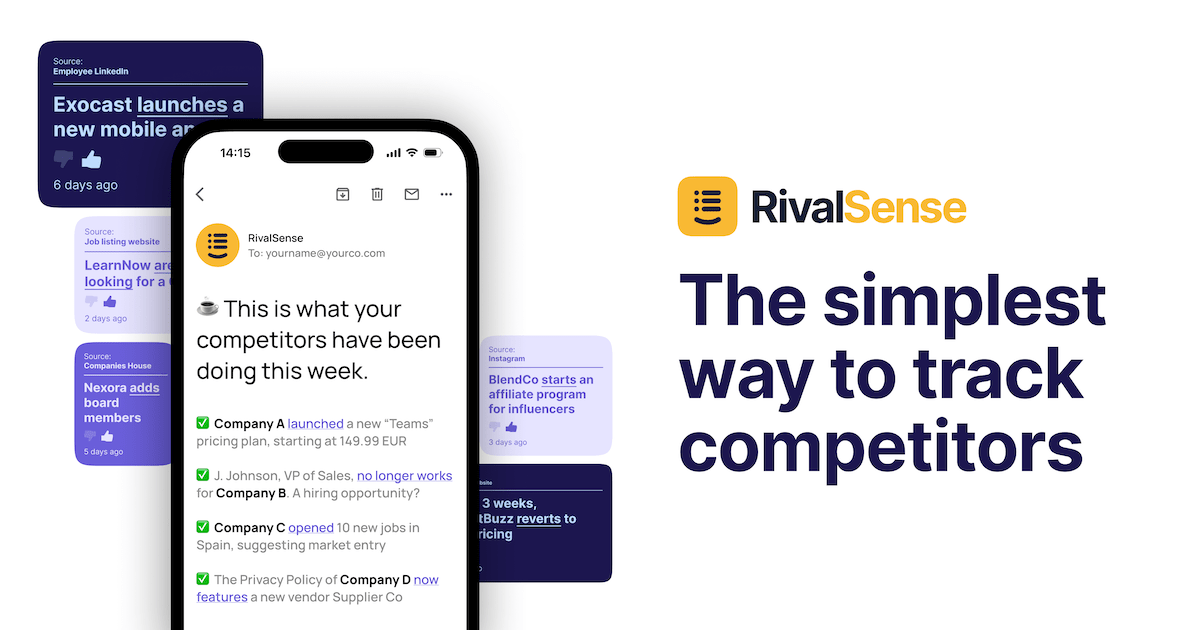
Keeping tabs on competitors used to mean me setting Google Alerts, skimming LinkedIn, and inevitably missing the news that actually mattered. RivalSense promises to do that monitoring for me and deliver one weekly digest. I tried it — here’s my honest review.
1. What Is RivalSense?
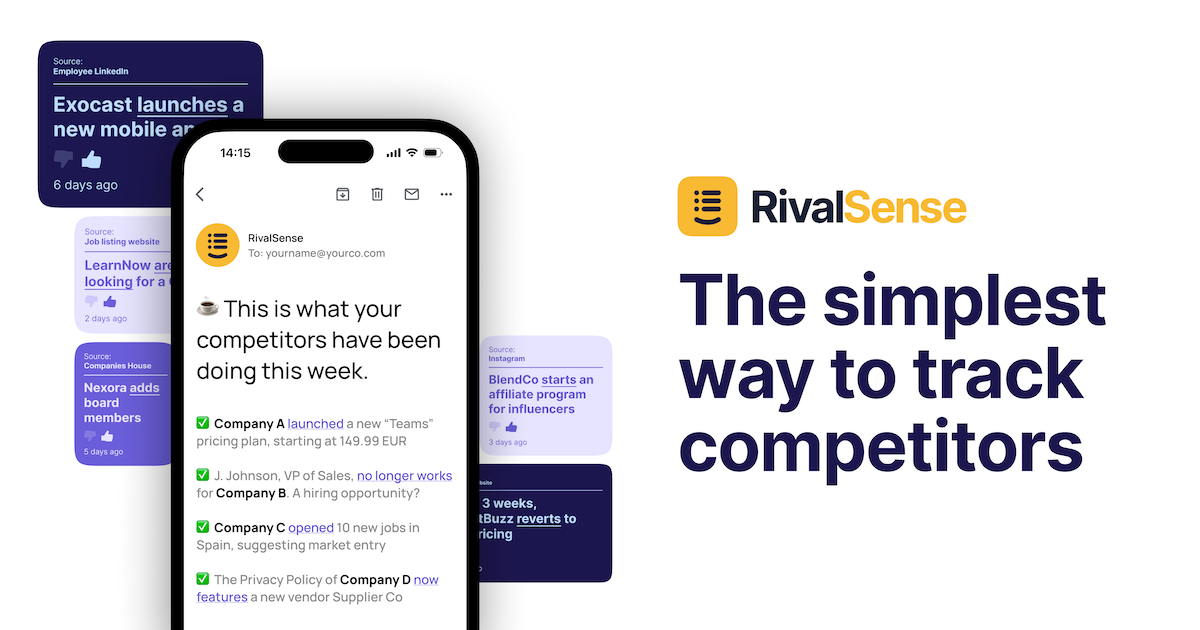
RivalSense is an AI competitive-intelligence tool. You input your competitors and pick the monitoring topics that matter to you, and its AI scours the web and sends a curated, readable update every week covering the most relevant competitor developments — product, distribution, hiring, client, and technical changes. It positions itself as turning web data into actionable strategic signals.
2. Who Is RivalSense Best For?
✅ Founders and product leaders
If you need to stay ahead of rival product launches and strategy shifts without doing the digging yourself, the weekly digest is exactly that.
✅ Sales and marketing teams
Tracking competitor hiring, clients, and distribution moves surfaces timing signals for positioning and outreach.
✅ Busy execs who want signal, not noise
The downvote-to-tune approach means the feed gets more relevant over time instead of flooding you with everything.
❌ Teams needing real-time alerts
RivalSense delivers weekly curated updates, so if you need instant, minute-by-minute alerting it’s not built for that.
❌ Solopreneurs on a tight budget
Entry pricing is aimed at businesses, so hobbyists may find it more than they need.
3. Core Features Breakdown
3.1 Weekly Curated Digest
The heart of the product: every week you get one readable summary of the most relevant competitor developments, rather than a firehose of raw alerts.
3.2 Topic-Based Monitoring
You select the areas most relevant to your business — product, hiring, clients, technical, distribution — and RivalSense prioritizes those.
3.3 AI Relevance Tuning
Downvote insights that aren’t interesting and the AI adjusts what it surfaces, so the feed improves with use.
3.4 Searchable Archive
All past updates are stored in a searchable archive, so you can look back at a competitor’s trajectory over time.
4. Pricing
RivalSense offers three main plans (prices in USD per month), differing mainly by how many companies you monitor:
Basic — $44.99/month, starting at 4 monitored companies, with a searchable archive.
Pro — $104.99/month, starting at 10 monitored companies, up to 5 email recipients.
Business — $222.99/month, starting at 20 monitored companies.
The per-monitored-company cost drops on higher tiers (roughly $10.99 down to $5.99 per company). Check the live pricing page for current figures and any trial.
5. Pros & Cons
Pros: Hands-off weekly digest saves real research time; topic prioritization plus downvote tuning keeps it relevant; searchable archive; covers multiple signal types (product, hiring, clients, technical).
Cons: Weekly cadence, not real-time; entry price is business-oriented; monitoring is only as good as the sources the AI can reach online.
6. RivalSense vs Manual Monitoring
Doing this yourself with Google Alerts and manual checks is free but noisy, inconsistent, and time-consuming — and you inevitably miss things. RivalSense trades that for a paid, curated, AI-filtered digest that arrives on schedule and improves as you tune it. If your time is worth more than the subscription and competitor intel actually drives your decisions, the automation pays off; if you only track one or two rivals casually, manual alerts may be enough.
7. Final Verdict: Is RivalSense Worth It in 2026?
For teams that genuinely act on competitive intelligence, RivalSense removes the tedious part and delivers a focused weekly read. The weekly (not real-time) cadence and business-level pricing are the main considerations. If competitor moves shape your roadmap or sales, it’s a sensible, time-saving tool.
Frequently Asked Questions
What does RivalSense do?
It monitors competitors you choose and sends a curated weekly digest of the most relevant developments.
How often do I get updates?
Updates arrive weekly as a single readable summary.
What kinds of developments does it track?
Product, distribution, hiring, client, and technical developments, prioritized by the topics you select.
Can I make it more relevant?
Yes, you can downvote insights that aren’t useful and the AI adjusts what it surfaces.
How many competitors can I monitor?
Plans start at 4 companies (Basic) and scale to 10 (Pro) and 20+ (Business).
👉 Where to Get RivalSense
You can start monitoring competitors here: Try RivalSense.
Affiliate disclosure: this post contains an affiliate link. If you sign up through it I may earn a commission at no extra cost to you. All opinions are my own based on hands-on testing.