Introduction: Why Web Scraping Is Still Hard in 2026
Web scraping is essential for data-driven businesses. From market research and price monitoring to SEO analysis and lead generation, scraping public web data has become a core requirement for many companies.
However, scraping at scale is not easy. Developers often face issues such as:
This is where ScraperAPI comes in.
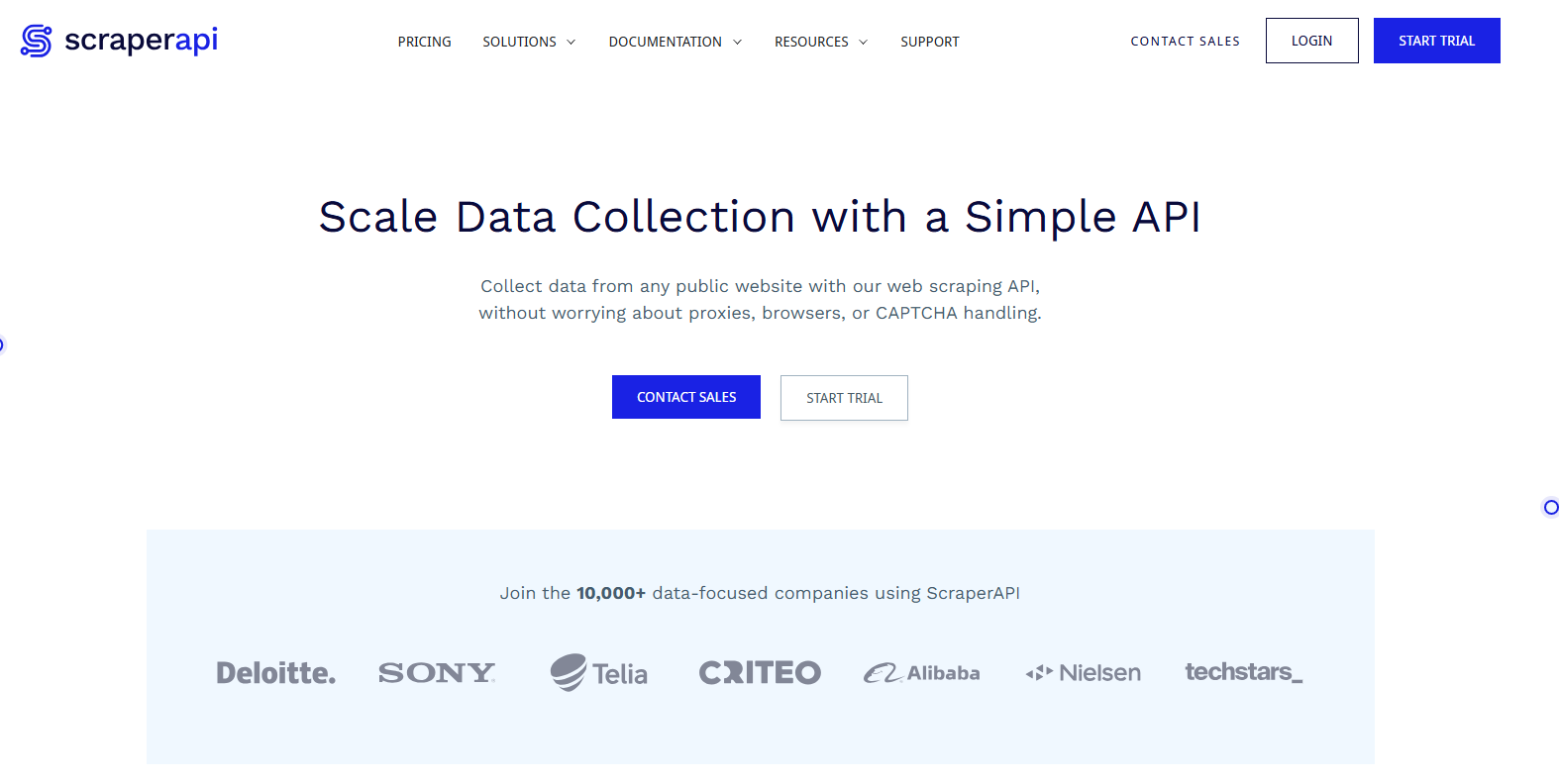
ScraperAPI positions itself as a simple, reliable web scraping API that handles all the hard parts of scraping, allowing developers and data teams to focus only on collecting data.
In this ScraperAPI review, we’ll take a detailed look at how it works, who it’s for, and whether it’s a good solution for large-scale scraping projects.
What Is ScraperAPI?
ScraperAPI is a web scraping API that enables users to fetch HTML from almost any website without managing proxies, browsers, or CAPTCHA solvers.
Instead of building and maintaining your own scraping infrastructure, you send your request to ScraperAPI, and it automatically:
ScraperAPI is widely used by developers, startups, SEO professionals, and data teams who need reliable and scalable web scraping.
👉 Official website: https://www.scraperapi.com/?fp_ref=finn
How ScraperAPI Works
ScraperAPI works as a middleware between your scraper and the target website.
You simply:
-
Send a request to ScraperAPI with your target URL
-
ScraperAPI fetches the page using its proxy network
-
You receive clean HTML or rendered content
ScraperAPI supports:
-
Standard HTTP requests
-
JavaScript rendering
-
Custom headers
-
Country-specific IPs
This approach dramatically reduces development time and maintenance costs.
Key Features of ScraperAPI
Automatic Proxy Rotation
ScraperAPI manages a large pool of rotating proxies to reduce IP bans and detection. You don’t need to buy or maintain proxy servers yourself.
CAPTCHA Handling
The platform automatically handles common CAPTCHAs, allowing scraping to continue without manual intervention.
JavaScript Rendering
For dynamic websites, ScraperAPI can render JavaScript pages using headless browsers, making it suitable for modern web apps.
Geolocation Targeting
ScraperAPI allows you to send requests from specific countries, which is useful for localized content, pricing, and SERP scraping.
High Reliability & Retry Logic
Failed requests are retried automatically to maximize success rates.
Simple API Integration
ScraperAPI works with any programming language that supports HTTP requests, including Python, Node.js, PHP, Java, and more.
Common Use Cases for ScraperAPI
ScraperAPI is commonly used for:
-
Web data extraction
-
SEO rank tracking and SERP scraping
-
Price monitoring and competitor analysis
-
Market research
-
Lead generation
-
Job listing aggregation
-
Real estate and travel data scraping
Its flexibility makes it suitable for both small projects and enterprise-scale data pipelines.
ScraperAPI Pricing Overview
ScraperAPI uses a request-based pricing model, making it easy to scale based on usage.
Plans typically include:
-
Free Trial: Limited requests for testing
-
Hobby / Startup Plans: Suitable for small projects
-
Business & Enterprise Plans: High request limits, priority support
Pricing depends on:
Compared to building in-house scraping infrastructure, ScraperAPI is cost-effective and predictable.
Pros and Cons of ScraperAPI
Pros
-
No proxy or CAPTCHA management required
-
Easy to integrate
-
High success rate on many websites
-
Supports JavaScript rendering
-
Scales well for large projects
Cons
-
JavaScript rendering uses more credits
-
Not a full data parsing solution (returns raw HTML)
-
Very complex sites may still require custom logic
Is ScraperAPI Legit and Safe?
Yes, ScraperAPI is a legitimate and widely used web scraping service.
It provides infrastructure support only. Users are responsible for:
-
Respecting website terms of service
-
Complying with data protection regulations
-
Scraping only publicly available data
ScraperAPI does not collect or sell scraped data.
Final Verdict: Is ScraperAPI Worth It?
ScraperAPI is an excellent choice for developers and data teams who want to simplify web scraping without managing proxies, browsers, or CAPTCHAs.
It is not a magic solution for every scraping challenge, but for most use cases, it dramatically reduces complexity and operational overhead.
If you need a reliable, scalable, and developer-friendly web scraping API, ScraperAPI is definitely worth considering.
👉 Try ScraperAPI here: https://www.scraperapi.com/?fp_ref=finn
✅ FAQ – ScraperAPI
What is ScraperAPI used for?
ScraperAPI is used to collect data from websites by handling proxies, CAPTCHAs, and IP rotation automatically.
Does ScraperAPI support JavaScript-heavy websites?
Yes, ScraperAPI supports JavaScript rendering using headless browsers.
Is ScraperAPI legal?
ScraperAPI is legal to use for scraping publicly available data, but users must comply with website terms and local regulations.
Can ScraperAPI bypass CAPTCHAs?
ScraperAPI automatically handles many common CAPTCHA systems to improve success rates.
What programming languages does ScraperAPI support?
ScraperAPI works with any language that can send HTTP requests, including Python, JavaScript, PHP, Java, and Ruby.
Does ScraperAPI provide parsed data?
No, ScraperAPI returns raw HTML or rendered content. Parsing must be done by the user.
Is there a free trial for ScraperAPI?
Yes, ScraperAPI offers a free trial with limited requests so users can test the service.