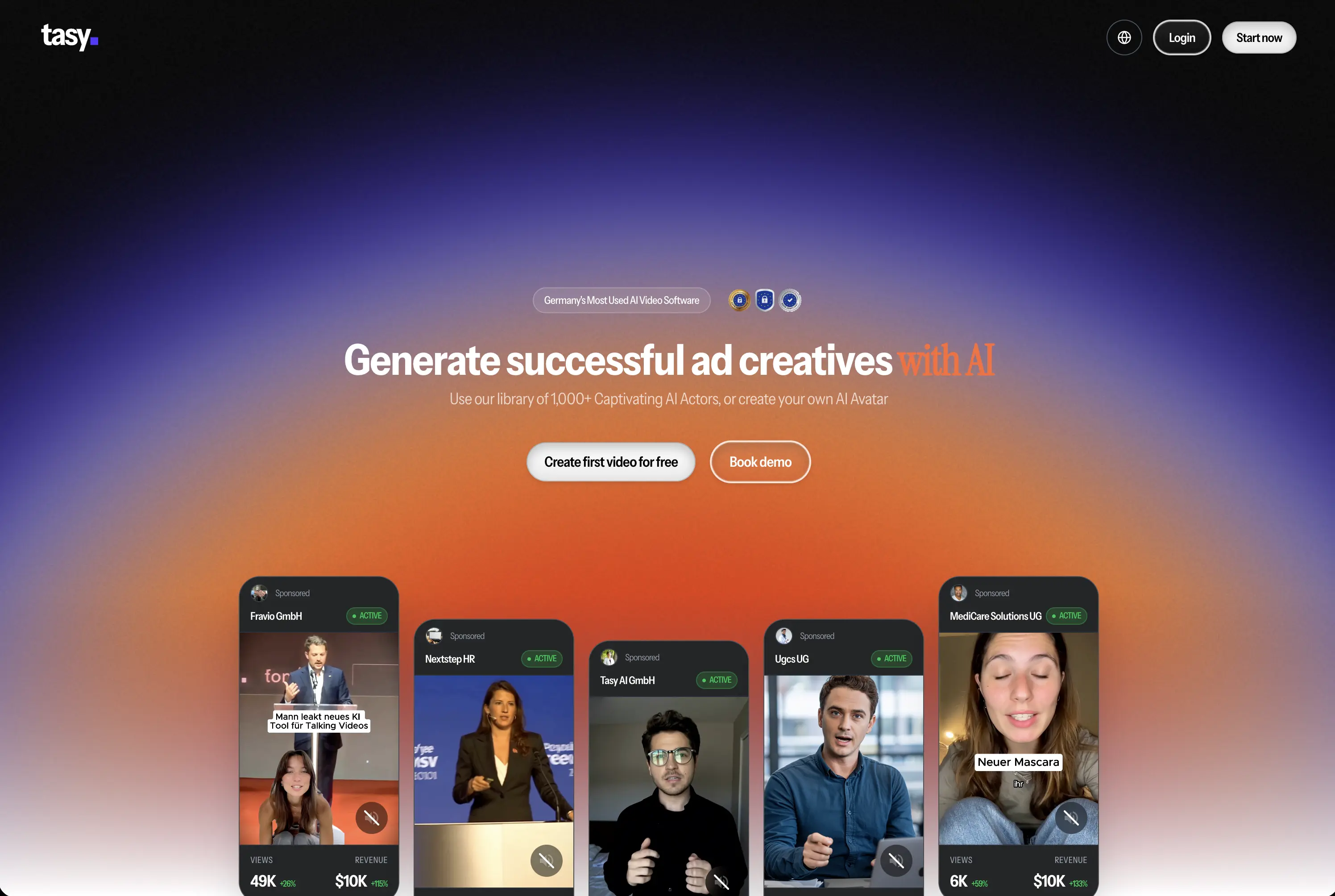
I create a lot of short-form video ads, and the promise of “type a script, get a scroll-stopping UGC video” usually falls flat. So I went into Tasy.ai expecting to be underwhelmed. Instead, I found one of the more capable AI creator-video tools I’ve tested this year. Here’s my honest first-person review.
1. What Is Tasy.ai?
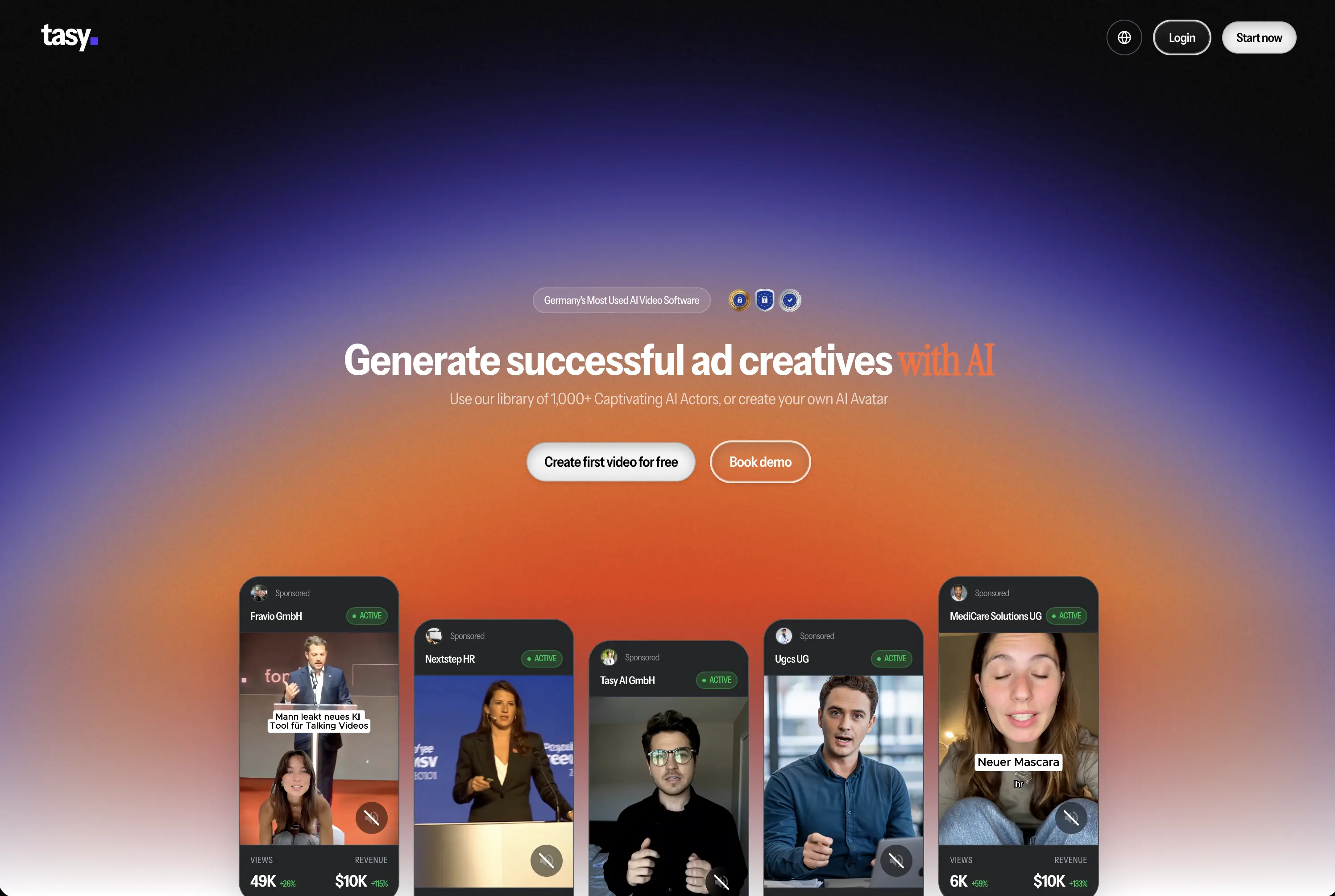
Tasy.ai is an AI video generator focused on UGC-style creator ads — the kind of authentic-looking, talking-avatar clips that perform well on TikTok, Reels, and paid social. You pick from 50+ professional AI avatars, write or generate a script, choose from 47 languages, and it produces a finished video in minutes. Under the hood it taps a stack of current models (it lists Sora 2, GPT Image, Seedance, Nano Banana Pro, and Kling Video), and it bundles features like subtitles, B-roll, character swap, and text-to-video. The company says it’s trusted by 500+ brands.
2. Who Is Tasy.ai Best For?
✅ Performance marketers scaling ad creative
If you need to test 10 — or 10,000 — ad variations a month, Tasy is built for volume. This is its sweet spot.
✅ DTC and e-commerce brands
Product-focused UGC ads without hiring creators for every SKU is a real cost saver, and Tasy leans hard into this use case.
✅ Multilingual campaigns
With 47 languages and 20+ native-speaker voices, teams running ads across markets can localize fast.
❌ Creators who want fully original, human authenticity
These are AI avatars. If your brand hinges on a real, recognizable human face, this isn’t a substitute.
❌ Anyone needing pure organic “real customer” testimonials
AI creators are not real customers, and presenting them as such is a problem (more on that below).
3. Core Features Breakdown
3.1 50+ AI avatars & custom avatars
The Basic tier uses the stock avatar library; Business and above unlock unlimited custom avatars, so you can build a consistent brand spokesperson.
3.2 Multi-model generation
Tasy exposes a lineup of leading generation models (Sora 2, Kling Video, Seedance, GPT Image, Nano Banana Pro) rather than locking you to one engine — useful when one model nails a shot another can’t.
3.3 UGC ad toolkit
Auto subtitles, B-roll insertion, character swap, text-to-video, and avatar images cover the practical editing steps that usually eat time after generation.
3.4 Scale & API access
Higher tiers add API access, unlimited product uploads, and universal usage rights, aimed at teams pushing high ad volume programmatically.
4. Pricing
Tasy.ai’s site served me pricing in euros, so I’m reporting it exactly as shown — I’m not converting currencies. Basic is listed at €59/mo, shown discounted to €29/mo (50% off): videos up to 1 minute, 720 credits/month, 1080p HD export, and all content-creation models. Business is €99/mo: videos up to 2 minutes, 2,699 credits (~35 videos), unlimited custom avatars, unlimited product uploads, universal rights, priority support, and API access. Enterprise (marked as a recommended offer) is €198/mo: videos up to 5 minutes and 5,398 credits (~71 videos). Promotional discounts change often, so confirm the live price on their site before you buy.
5. Pros & Cons
Pros: Strong roster of current generation models; genuinely fast script-to-video workflow; 50+ avatars and 47 languages for localization; built-in UGC editing tools (subtitles, B-roll, character swap); API access and unlimited custom avatars on higher tiers; credit allowances scale clearly with each plan.
Cons: Credit-based limits mean heavy users can burn through allowances quickly; Basic caps videos at 1 minute; pricing shown in euros may not match your local currency; AI avatars can still read as “AI” to sharp-eyed viewers; you carry the compliance burden of disclosing AI content.
6. Tasy.ai vs Hiring UGC Creators
The honest comparison is Tasy versus paying human UGC creators. Real creators bring authentic nuance and genuine testimonials, but they’re slow, expensive per video, and hard to scale or iterate. Tasy flips that: near-instant variations, tiny marginal cost, and full creative control — at the price of that human authenticity. For high-volume ad testing where you need dozens of variants, AI wins on economics; for a flagship brand story that needs a real face and real trust, human creators still matter.
7. Final Verdict: Is Tasy.ai Worth It in 2026?
If your job is pumping out and testing UGC-style ad creative at scale, Tasy.ai is a legitimately strong tool — the model lineup is current, the workflow is fast, and the tiers map sensibly to volume. It’s not a replacement for real human authenticity, and you’ll want to watch credit usage and disclosure obligations. But for performance marketers and DTC brands, it earns its spot. Start on Basic to feel out credit burn before scaling up.
Frequently Asked Questions
What is Tasy.ai used for?
Generating AI creator/UGC-style video ads with avatars, scripts, subtitles, and multi-language support for social and paid media.
How much does Tasy.ai cost?
As shown on their site in euros: Basic €59/mo (discounted to €29), Business €99/mo, and Enterprise €198/mo. Confirm live pricing before buying.
Which AI models does Tasy.ai use?
It lists Sora 2, GPT Image, Seedance, Nano Banana Pro, and Kling Video among its content-creation models.
Can I create custom avatars?
Yes — unlimited custom avatars are included on the Business and Enterprise plans.
Do I need to disclose that videos are AI-generated?
Yes. AI creators are not real customers, and platforms like TikTok, Meta, and YouTube require disclosure of synthetic/AI content. Don’t present AI avatars as genuine customer testimonials.
👉 Where to Get Tasy.ai
If you want to test AI UGC ads at scale, you can start here: Visit Tasy.ai →
Affiliate disclosure: This post contains an affiliate link. If you sign up through it, I may earn a commission at no extra cost to you. Responsible-use note: always disclose AI-generated content per platform rules and never misrepresent AI avatars as real customers.